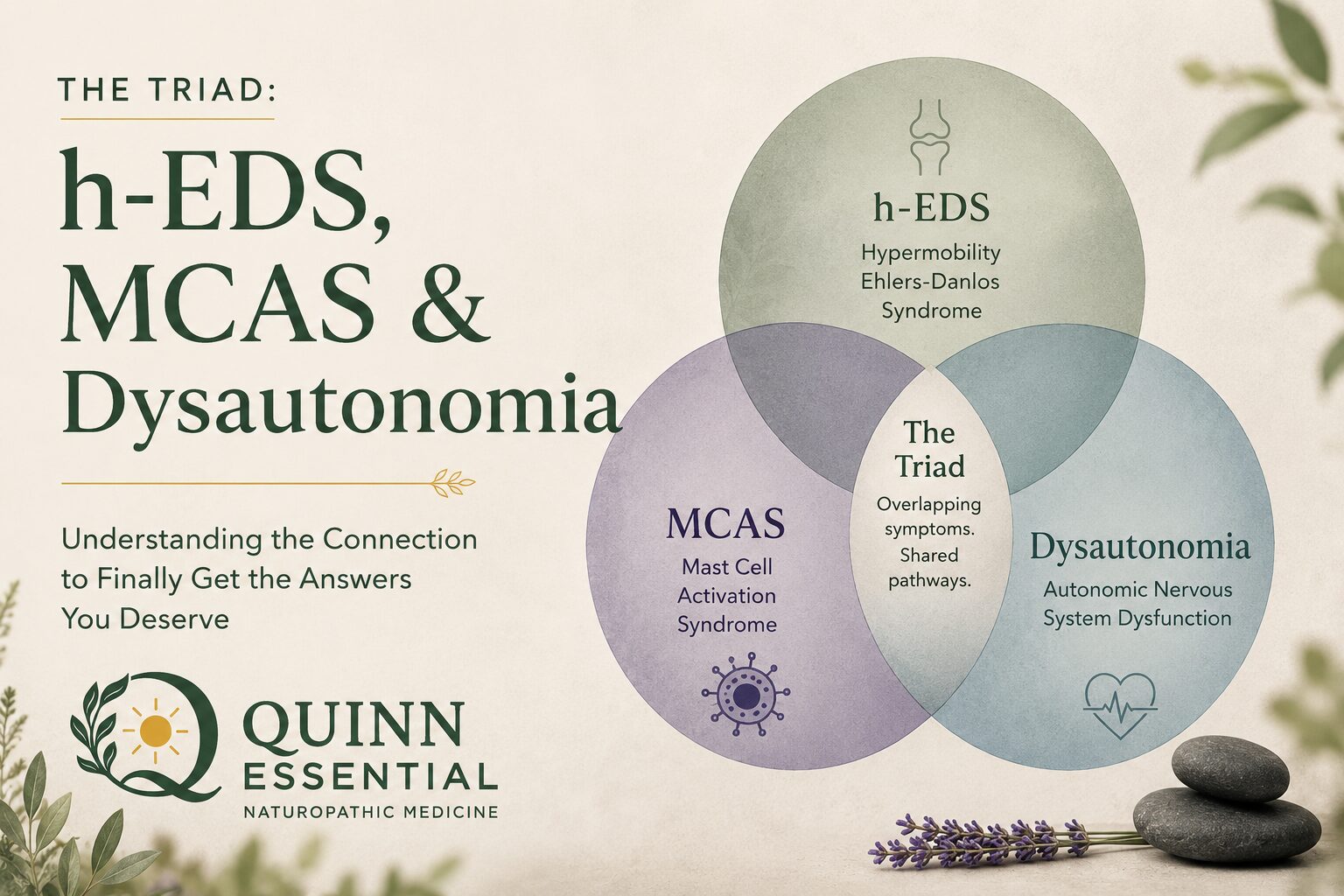
Many patients spend years bouncing between specialists before anyone recognizes that their symptoms may not be isolated problems, but rather part of a larger interconnected picture. One of the most commonly overlooked patterns we see in complex chronic illness is the “triad” of hypermobile Ehlers-Danlos syndrome (hEDS), mast cell activation syndrome (MCAS), and dysautonomia. While each condition can exist independently, they frequently overlap — and when they do, they can create a confusing constellation of symptoms that often leaves patients feeling dismissed, exhausted, and without answers.
Hypermobile Ehlers-Danlos syndrome is a connective tissue disorder that affects the body’s collagen and structural integrity. Patients may experience joint hypermobility, frequent sprains or dislocations, chronic pain, easy bruising, gastrointestinal dysfunction, headaches, pelvic floor dysfunction, and significant fatigue. Because connective tissue exists throughout the entire body, hEDS is rarely “just a joint issue.” It can impact multiple systems simultaneously.
Dysautonomia, including conditions such as postural orthostatic tachycardia syndrome (POTS), involves dysfunction of the autonomic nervous system — the system responsible for regulating heart rate, blood pressure, temperature, digestion, and more. Patients may experience dizziness, rapid heart rate, fainting, exercise intolerance, adrenaline surges, temperature dysregulation, brain fog, nausea, and profound fatigue. In patients with hEDS, connective tissue laxity may contribute to blood vessel instability and impaired circulation, which can worsen autonomic symptoms.
Mast cell activation syndrome adds another layer of complexity. Mast cells are immune cells involved in allergic and inflammatory responses. In MCAS, these cells become overly reactive and release inflammatory mediators inappropriately. Symptoms can vary dramatically and may include flushing, hives, itching, sinus congestion, gastrointestinal symptoms, headaches, chemical sensitivities, palpitations, anxiety-like symptoms, and reactions to foods, medications, or environmental triggers. Many patients do not present with “classic allergies,” which can make diagnosis challenging.
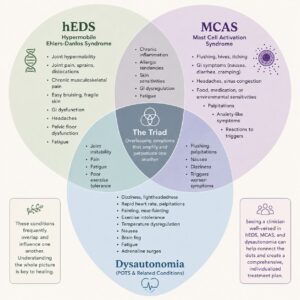
What makes this triad particularly difficult is that symptoms often overlap and amplify one another. A patient may initially seek care for gastrointestinal issues, chronic fatigue, migraines, anxiety, or unexplained pain without realizing these symptoms could all be connected. One specialist may focus only on the cardiovascular symptoms, another only on the gastrointestinal symptoms, and another only on the musculoskeletal complaints. Without someone stepping back to look at the full clinical picture, the underlying connections may be missed entirely.
Unfortunately, many patients with this triad are told that their symptoms are “just stress,” anxiety, or psychosomatic because conventional testing may appear relatively normal despite significant functional impairment. This can lead to years of frustration, medical gaslighting, and delayed care.
This is why working with a physician who is well-versed in all three conditions can be so important. Recognizing the relationship between hEDS, MCAS, and dysautonomia requires pattern recognition, careful history-taking, and an understanding of how these systems interact with one another. When clinicians understand the overlap, treatment becomes far more individualized and comprehensive.
For example, a patient with dysautonomia may continue struggling despite increased salt and fluid intake if mast cell activation is simultaneously driving inflammation and vascular instability. A patient with chronic pain and fatigue may not improve if underlying autonomic dysfunction and histamine-related inflammation are never addressed. Treating one piece in isolation often leads to incomplete improvement.
At Quinn Essential Naturopathic Medicine, we believe that connecting the dots matters. Complex chronic illness deserves a thoughtful, systems-based approach that considers the entire patient rather than isolated symptoms or diagnoses. While there is rarely a single “quick fix,” identifying these overlapping patterns can help patients finally feel understood and move toward a more targeted and supportive treatment plan that treats the individual as a whole person and addresses underlying triggers.
If you suspect you may be dealing with symptoms related to hEDS, MCAS, dysautonomia, or a combination of the three, know that you are not alone — and that your symptoms deserve to be taken seriously. Comprehensive care begins with listening, looking at the bigger picture, and understanding how interconnected the body truly is.